A Guide to Visa CEDP
Enhanced data refers to detailed Level 2 and Level 3 invoice information sent with a payment. CEDP emphasizes that this data must reflect real, accurate invoice details, not placeholders or generic values.
To qualify for enhanced data interchange rates, your transaction must include complete, accurate, and properly structured invoice data when it is submitted for payment.
This typically means:
-
Including all required header-level fields
-
Providing detailed line-item data
-
Ensuring all values are consistent and reconcile correctly
-
Submitting data in structured fields, not notes or PDFs
Even if you have the right information, transactions may not qualify if:
-
Data is incomplete or inconsistent
-
Fields are formatted incorrectly
-
Totals do not match across line items
Consistent data quality over time, not just one-off accuracy, is what determines whether you reliably qualify for lower rates.
CEDP reflects a broader shift in B2B payments.
Commercial card programs rely on high-quality invoice data for reporting, compliance, and reconciliation. When that data is incomplete or inconsistent, it creates more manual work and increases risk across the ecosystem.
B2B companies that consistently provide complete, accurate data are more likely to qualify for better rates, while poor-quality data leads to downgrades. Simply put, better data leads to better results.
Visa CEDP FAQs
Card networks, like Visa, are shifting from checking whether data is present to evaluating the quality of that data. This means:
-
Stricter formatting and accuracy requirements
-
More advanced validation (e.g., detecting mismatched totals or placeholder values)
-
Greater sensitivity of pricing outcomes to data quality
Bottom line: qualification now depends on consistent data performance, not just submission.
While CEDP is a Visa initiative, it reflects a broader industry trend toward data-driven validation, increased automation, and greater emphasis on accuracy and consistency.
It’s likely that similar standards will expand across payment networks over time.
Having data means the information exists somewhere, often in PDFs, notes, or disconnected systems. Usable data means it is structured, complete, consistent, and ready to be processed and validated automatically.
CEDP requires usable data, not just available data.
Common issues include:
-
Totals that don’t reconcile across line items
-
Missing ship-to information
-
Freight bundled into item pricing
-
PO numbers stored in notes instead of structured fields
-
Tax mismatches or incorrect indicators
-
Missing units of measure
Fixing these issues can significantly improve qualification rates.
A downgrade occurs when a transaction fails to meet the requirements for a lower-cost processing category and is instead charged at a higher rate.
This often happens when required Level 2 or Level 3 data is missing, incomplete, incorrect, or poorly structured.
For example, a transaction may be downgraded if:
-
A PO number is missing or stored in a note instead of a structured field
-
Line-item totals don’t reconcile with the invoice total
-
Tax or shipping information is inconsistent
Downgrades can increase processing costs and reduce visibility into final fees.
In many cases, businesses are unaware downgrades are happening until they see higher-than-expected costs, making data quality a critical factor in controlling payment expenses.
“Verified” businesses consistently send complete and accurate invoice data and are more likely to qualify for optimal rates.
“Non-verified” businesses send inconsistent or incomplete data and are more likely to experience downgrades and higher costs.
This new classification from Visa prioritizes consistency over time, not perfection.
Level 2 and Level 3 data refers to enhanced transaction details that businesses submit with commercial card payments to qualify for lower processing rates.
Level 2 data includes basic additional fields such as:
-
Sales tax amount
-
Customer or department code
-
Invoice or purchase order (PO) number
Level 3 data includes everything in Level 2, plus detailed line-item information, such as:
-
Product or service descriptions
-
Quantity and unit price
-
Total per line item
-
Shipping, tax, and destination details
Under CEDP, Level 2 will no longer exist as a category for Visa starting April 2026. While the Level 2 classification will continue to apply for the other card networks, Visa is moving to a “qualified” or “non-qualified” model. And, qualification will be determined by AI.
The more complete and accurate your data, the more likely your transactions are to qualify for the best possible interchange rates.
If required fields are missing or inconsistent, transactions can be downgraded to higher-cost categories. This can lead to:
-
Increased processing fees
-
Delayed visibility into final interchange costs
- More manual work during reconciliation
CEDP impacts multiple parts of your business, including:
-
Accounts Receivable (invoice creation)
-
Finance/Treasury (cost management)
-
ERP and related systems (data structure and integration)
Because invoice data drives payment outcomes, alignment across these areas is key.
To get started, your teams can:
-
Use structured fields on invoices instead of notes or PDFs
-
SKU/commodity codes and units of measure
-
Use invoice templates that require key fields
-
Ensure line-item math matches the invoice total
-
Contact your payment provider to ensure they support the additional transaction data collection
Small process improvements can lead to meaningful cost savings.
“Good data” means:
-
Required fields are complete
-
Line items are clearly defined
-
Totals reconcile across the invoice
-
Data is structured in fields, not buried in notes or PDFs
It’s not just about having data, it’s about having it in the right format.
You may be at risk if:
-
Key fields (PO, tax, shipping) are inconsistent or optional
-
Line-item data is incomplete or unclear
-
Your payment provider does not review or validate your data
Even small inconsistencies can lead to higher processing costs.
Preparation time depends on your current processes. B2B companies with structured, consistent invoice data may require minimal changes. Others may need to standardize fields and improve data capture processes.
Better data improves reconciliation by:
-
Making transactions easier to match to invoices
-
Reducing manual corrections
-
Increasing visibility into payment details
Poor data has the opposite effect, more manual work and errors.
Responsibility is shared:
-
AR teams ensure invoice data is accurate and complete
-
Finance teams monitor cost impact and performance
-
Payment providers submit the data (the best providers work with you to ensure the invoice data aligns with CEDP requirements)
Success depends on coordination across all three.
Yes, in many cases but not necessarily in a disruptive way.
CEDP requires that invoice data be captured in a structured, consistent format before payment. If your current process relies on PDFs, notes, or inconsistent fields, adjustments may be needed to ensure your data meets the new standards.
If your data does not meet CEDP requirements:
-
Transactions may be downgraded to higher-cost categories
-
You may experience less visibility into final costs
-
Manual reconciliation work may increase
Over time, this can significantly impact margins and operational efficiency.
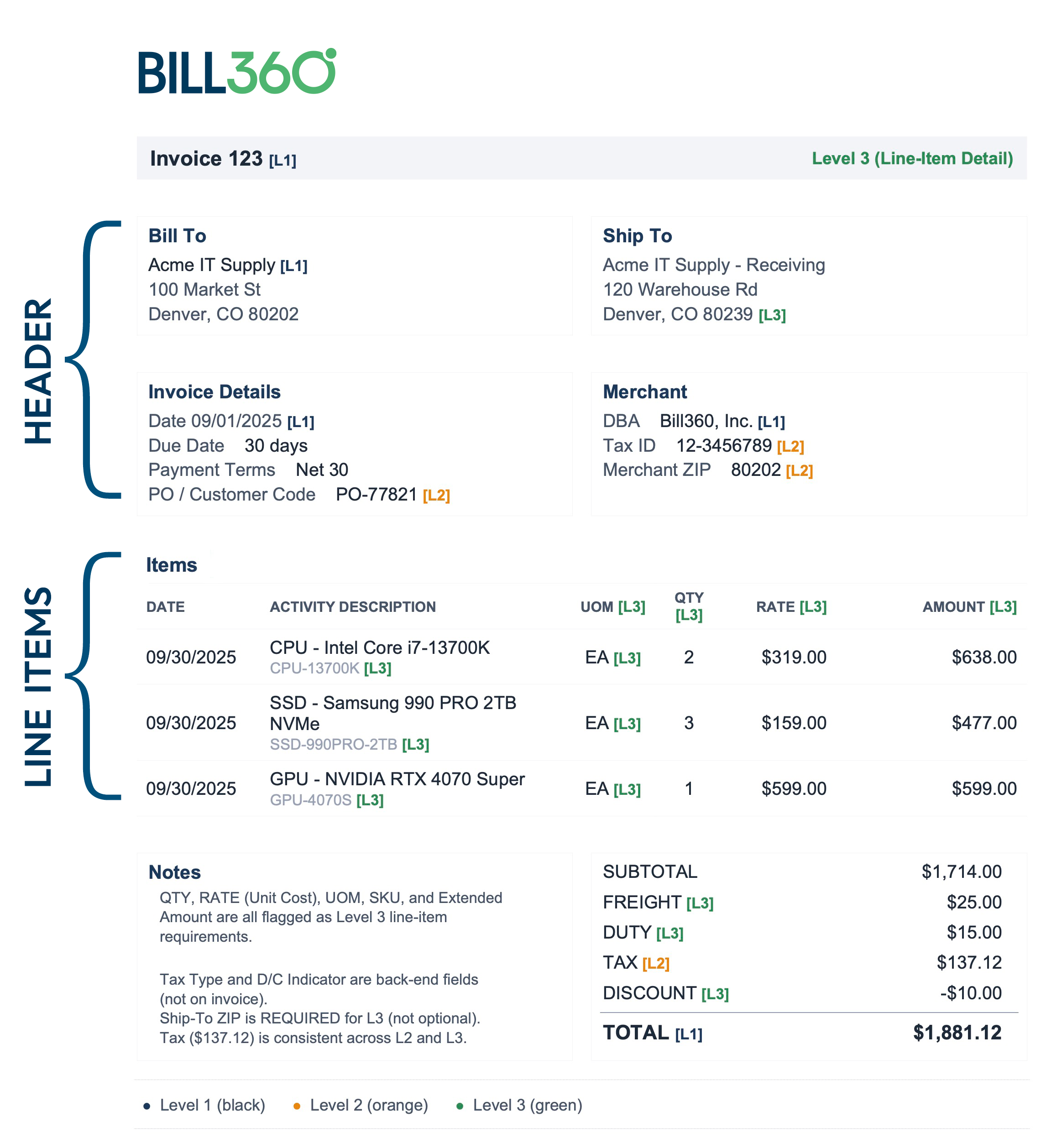
The essential parts of an invoice
If the information below is updated, accurate, and sent with the payment, you have a better opportunity to lower your processing costs.
Invoice header data:
-
Invoice or order ID
-
Purchase order (PO) number (in a structured field)
-
Tax amount and indicator
-
Merchant ZIP/postal code
-
Invoice date and currency
Line-item data:
-
Item description or SKU
-
Quantity and unit of measure
-
Unit price and total amount
-
Tax, freight, and discounts (clearly separated)
-
Ship-to ZIP code and country

How Bill360 helps.
Visa’s CEDP is not a compliance update, it’s a structural shift in how B2B payments are validated and priced. While others are reacting to CEDP, Bill360 was built to capture complete and accurate invoice-level payment data from the start.